
In the fall of 2002, I was an American college student studying abroad in London. It was the time of Tony Blair and George Bush and massive September protests in central London.
One march was against the coming U.S.–British invasion of Iraq. Another was a demonstration in support of fox hunting in the British countryside, a “sport” in which dogs chase and tear foxes apart as humans follow on horseback.

I hadn’t thought much about that pro–fox hunting demonstration until now. Memories from London that stuck with me instead include: my flatmate who had never eaten a peanut butter and jelly sandwich but did share her Vegemite; the free-roaming (and almost certainly bird-killing) cat that would enter my bedroom at night through an open window and sleep on my legs until morning; and the way the handyman in our student flats greeted us, in a fantastic Cockney accent: “Alright, darling?”
I bring all this up—memories of myself as an American in England, protests both for and against killing—because it’s what comes to mind as I contemplate what to say about Starlings: The Curious Odyssey of a Most Hated Bird by Mike Stark.
Hubris & consequences
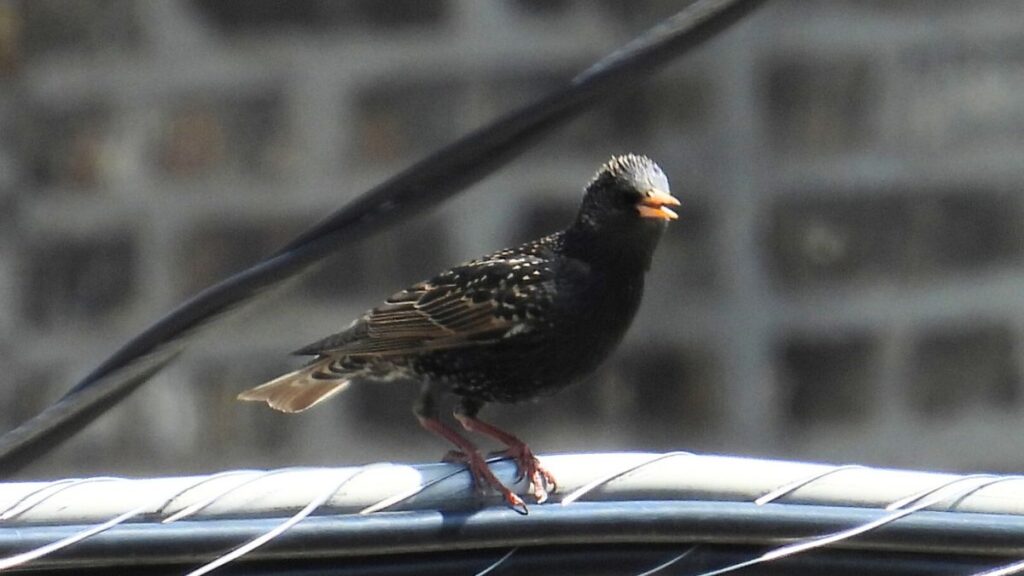
Stark’s book is well researched, and I learned a lot about the history of the European starling (Sturnus vulgaris), a songbird native to England and Europe that was introduced to the United States on purpose in the late 1800s by a wealthy New Yorker who released some in Central Park.
Eugene Schiefflin, president of the American Acclimatization Society, was part of a trendy movement being formed by elite men in France, England, and the United States. Their goal was to import nonnative species because they were beautiful, or interesting, or reminded them of home.
But like the earlier introduced house sparrow, the starlings didn’t stay in Central Park. They went on to not only survive, but thrive and spread across North America, quickly multiplying into millions and becoming an invasive pest species that flock together in huge numbers.
Chemical weapons & shotguns
Throughout his book, Stark details a litany of ways people have tried to scare away and exterminate starlings, including shooting them and gassing them with chemicals. Killing starlings is legal because they are an invasive species in the United States, as are house sparrows.
Starlings take over native birds’ nesting sites. They cause economic and physical damage in cities, suburbs, and agricultural areas. And they generally gross people out with the amount of corrosive, slippery, and smelly droppings they can produce in just one night (unbelievably, it’s multiple tons).
The birds have had their defenders, including biologist and Silent Spring author Rachel Carson and people who’ve kept starlings as pets. Still, throughout the 1900s, the U.S. military, local governments, and independent contractor “bird men” worked to kill starlings en masse. In most cases, the results were limited, and efforts seem futile.
‘Our own foolish behavior’
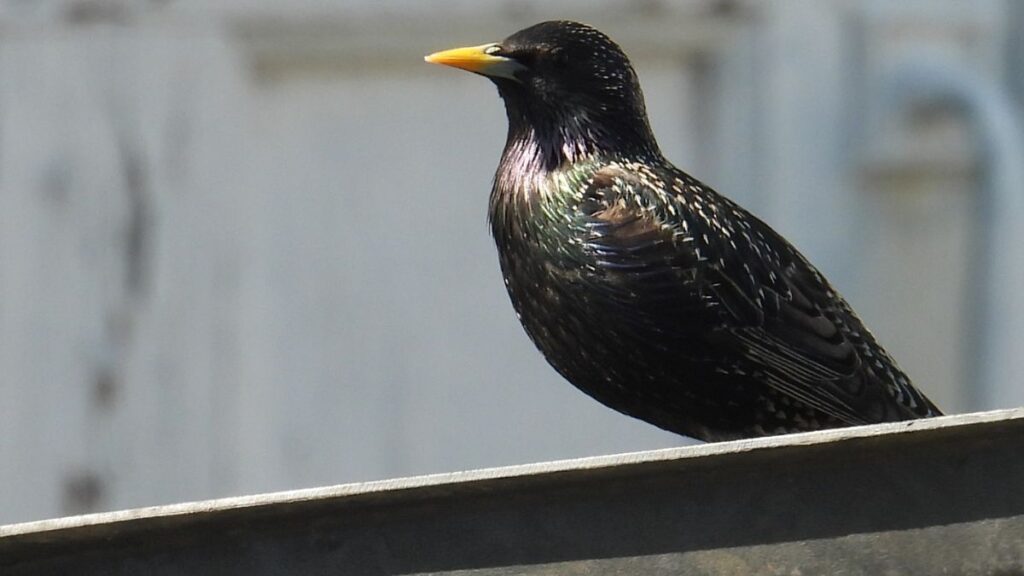
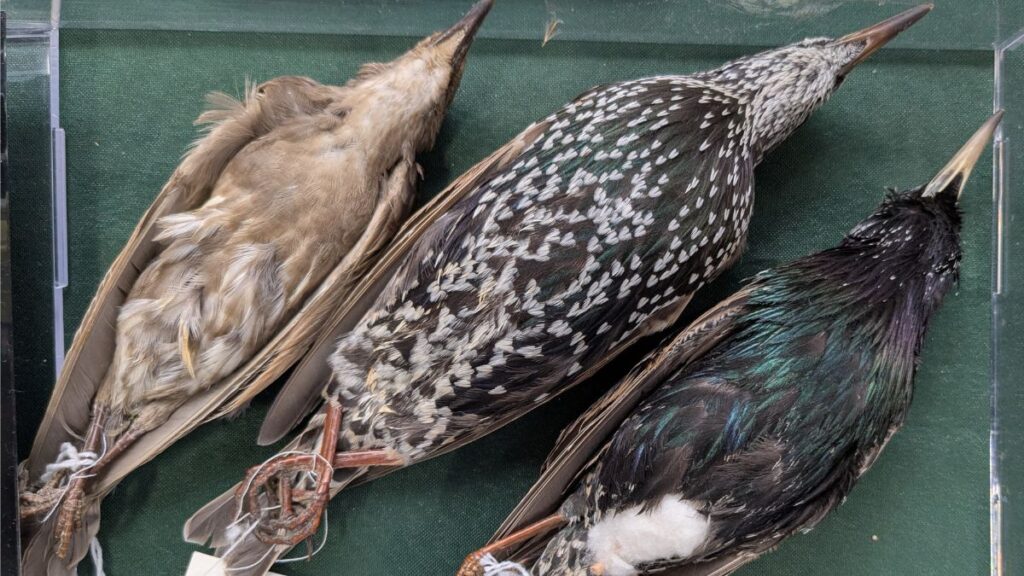
In the right light, starlings are beautiful. They’re dipped in dots, and they shine with purple and green. It’s not their fault they congregate by the thousands or millions and drop their droppings by the ton, causing slip-and-fall hazards, damaging equipment and buildings, killing trees, and possibly spreading diseases.
It’s not their fault they have the drive to evict Northern flickers and sapsuckers from their nesting cavities. And it’s not their fault they were brought to the United States. They didn’t ask to study abroad! They’re just out here surviving, and we hate them for it. We even call them trash birds.
Toward the end of the book, Stark dives into his own complicated feelings about starlings:
“There’s part of me that feels obligated to join the call taken up by Rachel Carson … and others to be a few degrees more tolerant toward starlings. They’re among us now, and they’re not going away. Rather than reaching for a gun or explosives, perhaps we should occasionally pick up a pair of binoculars and look at these peculiar and intelligent birds in a new way. Maybe in a moment of suspended disgust, there’s a chance to reflect on one of nature’s flying wonders, however out of place.”
And yet:
“I certainly don’t want to live in a world where local native species, especially those adapted to live in just a few place, are ousted by generalist species from afar, including those whose spread is facilitated by our own foolish behavior.”
What do we kill, and where?
In reading Stark’s book, I felt more empathy for the humans dealing with huge starling roosts than I had previously. Because while I do see relatively small flocks of them in the city and suburb where I live, they always leave to spend the night somewhere else (literally NIMBY). I haven’t experienced the literal tons of shit they can drop, and I’m not a farmer worried about my crops (although starlings could be beneficial in eating insects that harm crops).
The more I learn about the negative effects of invasive species like buckthorn and carp (and even overabundant native species like the white-tailed deer), the more I get why their populations need to be controlled, even if one dislikes killing living things.
‘The pursuit of the uneatable by the unspeakable’
Thinking back to that fox-hunting demonstration I witnessed in September 2002 in central London—did the protesters have a point? They were arguing that the fox hunt was their cultural heritage and a way to help farmers protect livestock from predation by native red foxes.
The more I learn about fox hunting, however, the more I see why most Brits are opposed to the practice.
Oscar Wilde called fox hunting “the pursuit of the uneatable by the unspeakable.” Traditional fox hunting involves sealing up underground burrows so that a fox cannot escape. Dogs find the trapped fox, corner it, bite it, and tear it apart.
“Fox hunting is not a credible form of pest control,” according the League Against Cruel Sports. “Hunters claim that they are helping farmers by killing foxes, but this is a senseless argument as farmers retain the right to control pests on their land.”
In 2004, England and Wales outlawed the practice of using dogs to hunt and kill foxes.
Still, the League admits, “no other native British mammal divides opinion as deeply as the red fox.”

Widespread & divisive
The red fox is an adaptable predator that’s found almost everywhere. There may now be as many as 10,000 red foxes living in London (see photos), and some have blamed the ban on hunting for an increase in their population.
Predictably, some people don’t like living with foxes. They can make a mess, leave stinky feces, and make a lot of noise. Still others appreciate them—if not for their inherent value, for their natural pest control, as foxes are opportunistic scavengers that will eat rats, mice, and rabbits.
And while red foxes are native to England, they have become problematic for native wildlife in some places. For example, in the 1700s, aristocratic English colonists introduced the red fox to the U.S. East Coast (and elsewhere) so they could hunt it.
In these introduced areas, red foxes can be considered a nuisance species with “a negative effect on populations of ground-nesting species, such as shorebirds, gamebirds, waterfowl and turtles, many of which are listed as threatened or endangered,” according to the New Jersey Agricultural Experiment Station at Rutgers.
In some cases, lethal methods are allowed.
Unknown unknowns
I don’t have a neat way to wrap up this post. So here’s a February 2002 quote from then-Secretary of Defense Donald Rumsfeld:
“But there are also unknown unknowns—the ones we don’t know we don’t know. And if one looks throughout the history of our country and other free countries, it is the latter category that tends to be the difficult ones.”
Leave a Reply